I arrived at the lecture hall half an hour early to secure myself a good seat, expecting the room to be crowded. Instead I found a dark empty room. How strange, I was expecting this to be a huge event. After all, the grandson and first male heir of a revolutionary man has come all the way to Toronto to speak to us.
As the event is about to start nearly an hour later, I’m embarrassed that there are no more than 15 people in the room from a student population of 70,000 at the University of Toronto. It seems as if people have completely forgotten how hard this man had fought for our human rights, changing the course of history forever.
His grandson; a young, tall, black man sits at the front of the room. There is a gentle aura around him that very few people carry. He and his family have been through so many troubles, yet, there he sits calmly with prayer beads in his hand, and a warm smile on his face resembling a wise grandfather, who is about to tell his grandchildren an interesting story.
After being introduced, he steps up to the podium, and starts off by reciting verses from the Qur’an in Arabic. His voice is quiet.
In the name of Allah, most gracious, most merciful.
There is no God but Allah and Muhammed is his Messenger.
May the praise and blessings of God be upon Muhammed and the progeny of Muhammed.
Alhamdullillah.
Then, with his voice full of pride says:
“My name is Malcolm Shabazz, and I’m the grandson, the namesake and personal heir of a great Muslim revolutionary leader, by the name of El-Hajj Malik El- Shabazz, or more widely known to the masses as Malcolm X.”
He asks, “By a show of hands how many of you have read the autobiography of Malcolm X written by Alex Haley?”
Quite a bit of hands were raised.
“That’s more than half. That’s good, Alhamdulillah. By a show of hands how many of you have seen the movie produced by Spike Lee?”
Even more hands are raised.
“Ok,” he nods.
He explained, he asked the same questions at Tennessee State University, which is considered to be a historical black university. He spoke at the African Studies department. There were a couple hundred people present, and when he asked how many of them read the book, surprisingly only one person raised their hand, which happened to be the Christian Baptist Minister who actually came with him. One-quarter of the audience watched the movie.

Martin Luther King
“For me this is something that is totally unacceptable and this is something that’s by design. In the United States, they promote Martin Luther King; we celebrate his birthday. We get the day off from school; it’s considered a holiday.
“But with my grandfather, he doesn’t really have a holiday. We don’t celebrate anything, and the reason for this is because those in power within the United States, they would rather us take the position of Martin Luther King, and not the position of my grandfather, Malcolm X.”
He spoke to a student the day before who said, in her class, they promote Martin Luther King and hold him in high regard, but when her teacher spoke of his grandfather, they associated him with violence.
Shabazz explains the differences.

Malcolm X
“My grandfather said that we should never be the aggressor, but if a man puts his hand on you, then you should make sure that he doesn’t have the ability to put his hand on anybody else. That you should defend yourself; you should defend your family; and you should defend your home.
“Martin Luther King, he had a philosophy, ‘turn the other cheek,’ which he adopted from Ghandi.
“Some people when they meet me, sometimes they say, ‘yeah, we support your grandfather, we don’t agree with Martin Luther King.’ This is divisive. I believe that my grandfather and Martin Luther King were both just as significant.”
Shabazz gave the audience a brief history of Malcolm X for those who might not be familiar.
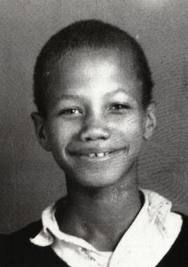
Malcolm X was described as “well-mannered and highly intelligent” by his white foster parents. He was the only black kid in class yet was voted as class president. Even though he was popular, everyone referred to him as “nigger.” They called him “nigger” so often, that he began to think of it as part of his name.

Malcolm X as a kid
“They didn’t call him nigger because they held any particular animosity towards him,” Shabazz said. “The racism was so thoroughly ingrained within the culture and of the people and politics of the society at that time and even up to today.”
Despite the fact that he was one of the top students at his junior high school, he dropped out in the eighth grade after being discouraged by his teacher who told him his aspirations of becoming a lawyer were “no realistic goal for a nigger.” He suggested him to be a carpenter, to do something with his hands.
Soon enough he began his life filled with crime. Right before he went to prison, he was involved in many burglaries of the wealthy. One day, he came across a particular watch that he liked, and decided to keep it. He left it for repairs at a jewelry shop, and when he came back to get it, he was arrested and sentenced to 10 years in prison.
While in prison, he argued against religion, against God. He was so discourageable, that the worst of the worst of prisoners (rapists, drug-dealers, gangsters) called him satan.
This gives us an idea of his mentality and mind state at this time.
Shabazz says, all of this may seem negative, but sometimes we have to take the good with the bad.
“I believe in something as a Muslim, it’s called pre-ordained; that everything is recorded clearly in a book and that everything happens for a reason.
“I’ve often been in situations, where I thought, ‘Why me? Why is this happening to me?’ But when I look back, I can understand why it is that I went through some of the hardships that I went through. And if I wouldn’t have went through the hardships that I went through, I don’t believe I would be standing before you here today.”
If his teacher had supported Malcolm X and his aspirations of becoming lawyer, he might have became a pretty good lawyer. But that means there would never have been a Malcolm

X.
“If there was never a Malcolm X, then who’s to tell where we would be at today? Something that can seem so insignificant in our lives could really change the whole course of the direction that we go in.
“If he would never have went back just to get that watch, he would have never got arrested and went to prison. And if this would have never happened, then maybe there would have never been a Malcolm X. So, Alhamdulillah, Allah is the best of planners and everything happens for a reason.”
He says he tries not to regret any situation because obstacles are placed within our lives to make us stronger.

Early in Shabazz’s life, he was constantly moving from one place to another. He remembers when he was 11-years-old in Texas looking up at the stars one night, asking himself, ‘Where will I be next year when I look up at the stars again?’ Every year, he would look up at the stars and reflect where he was the previous year and where he’d like to be the next.
“From one year to the next, things have never been as I planned them to be. Never.”
As a child, he didn’t know why exactly his family was held in such high regard in the community.
One instance when he realized why was when he was 10-years-old and just came back from summer camp. His grandma was dropping him off with a family he was staying with in Philadelphia. The lady was not home at the time and his grandma was in a rush so, she left him with $3,000 in cash and cheque to give to the lady.
Until the lady arrived, he decided to meet up with his friend, and they decided to go to the corner store to get something to eat. This was a rough neighbourhood, and he pulled out his big wad of money to pay. Naturally, a bunch of 16-year-olds noticed, and stole the money from him. He was too small to fight them.
Distressed, he sat on the steps, not knowing what he was going to do. A Muslim sister, wearing the hijab and abaya all in white, was passing by and asked him what was wrong.
Shabazz told her the story, and she told him, ‘don’t worry about it,’ and went inside to make a call.
Shortly after, 30 or so men came to him and asked him what happened. After hearing his story, they returned again and gave him back even more money than was stolen. The same boys that stole the money from him, returned to apologize.
“We didn’t know who you were, we apologize. If you ever have any problems please let us know,” they told him.
***Prison***
The prison in Attica, New York, where Shabazz was jailed for years has a 100 per cent white workforce and the majority of inmates are black and Hispanic. The prison is the town’s largest source of income; without it the employees would be farmers.

To give you an idea of the environment, the officers in this prison have tattoos of black babies hanging from trees.
“There’s people in here that are in here for life, they’re never coming home, they’re hardcore. And when I got there, one of the things they told me, they pulled me to the side, and said ‘Don’t look at any of them in the eye.’
“It was interesting. They were scared of them. In here, there’s about 3,500 inmates, 300 police. How do they keep control? Through divide and conquer. They throw all of these little things in the mix, to keep us fighting amongst each other. And that’s how they keep control.”
“Me, I just had problems with a lot of the police, who harboured an extreme amount of hatred towards me, simply because of my family’s lineage.”
He had some altercations and found himself in an upstate box with 23 ½ hours of lockdown, in Dannemora, New York next to the border of Canada.
He soon heard about a deputy superintendent there who was black, which is rare, so every time the gate would open, he would jump up to try to have some human contact.
One day he managed to catch up with the black officer, who was walking down the corridor.
Shabazz got excited and said, “Excuse me brother, let me talk to you for a minute!”
The officer came back with a look of disgust on his face.
“What did you call me?” he asked.
“I said brother,” Shabazz replied.
“What do you mean by brother?”
“You’re black. I’m black. That’s why I called you brother.”
“I’m not black.”
“You’re not black? What are you?”
“I’m French Canadian.”
Shabazz became annoyed when he heard that. Shabazz told him that he was born in France himself, but he doesn’t say that he’s a European or a Frenchman; he says he’s black.
“If they put an all-point bulletin on you, are they going to say ‘we’re looking for one French Canadian or are they going to say we’re looking for a black male?’” Shabazz asked.
“I wouldn’t be in that position,” was the officer’s response.
***Importance of education and unity***
When Malcolm X embarked on his pilgrimage to hajj, he had an awakening. This was at a time when few Americans had ventured outside of America. During his time abroad, he realized that the doctrine within the Nation of Islam was completely false. For instance, the Nation of Islam believed everyone in Mecca was black, and that you couldn’t even enter the city if you weren’t black.

Malcolm X was surprised to see white men with blue eyes and blonde hair sitting together with black men, eating from the same plate, drinking from the same cup, praying together. It was the first time in his life that he felt like a complete human being.
While traveling overseas, and meeting with different leaders, Malcolm X realized that we had to stop calling it a civil rights issue and isolating the problem because it was a human rights issue. He realized that their struggles needed to be linked with Africans in apartheid South Africa, with the struggles of the oppressed masses in South America, with the struggles of brothers and sisters in the Middle East, Shabazz explained.
“When he did that, he was then prepared to take the United States up on charges within the United Nations and this is when he became a real threat.”
He denounced his previous belief that the white man was the devil, and that never again would he put a blanket indictment on an entire group of people. There were white people who wanted to help him in the past, but he didn’t let them, which he regretted now.

“This position that the white man is the devil is divisive, and it actually served the agenda of those in power,” Shabazz explained. “It’s not actually about black and white. It’s about those select few in position of power who keep control through various divide and conquer tactics. So anything that’s divisive, it serves their agenda. When he came back and he started promoting unity, I guess they said ‘he has to go.’”
It was his grandfather who said, “Education is our passport to the future, for tomorrow only belongs to those who plan and prepare for it today.”
Sometimes people aren’t aware of their own plight that they’re in because they’re uneducated, Shabazz explained.
An example would be Harriet Tubman who freed many slaves through her Underground Railroad into Canada. One of the things that Tubman said was that she could have freed a lot more slaves if only they had realized that they were slaves. This was during a time of physical slavery, when African Americans were being whipped and bounded by chains and shackles.

“Due to their thorough indoctrination, you couldn’t convince them to try to run away from the plantations. They just felt like they were slaves, doing the physical slavery, and this is something that extends all the way up until today, where we have people that are slaves, and they don’t realize that they’re slaves,” Shabazz said.
It’s like a stray dog, Shabazz explains. You might try to pet it, but since it doesn’t know you, it might bite you, it might try to flee. But once you subdue the dog, put a leash on it, tie it to a tree and keep it there for some time, feed it every time it gets hungry, it becomes dependent on you.
“There will come a time where you can take the leash off of the dog and it won’t run or snap at you, it will stay there right by your side. And it’s unfortunate that this is what happens today.
“If you look at the youth of today, they don’t know what was going on 20, 40 years ago. If you don’t know what was going on 20, 40 years ago, you don’t even know what’s going on right now.”
While students in private schools excel in their studies, public schools are having trouble affording updated books, Shabazz said. As rapper Nas says in his lyrics: “Niggaz play with Play Stations, they build a Space Stations.”
As a kid, whenever Shabazz would watch typical war movies with the two opposing forces marching head on towards each other on a battlefield, he would always think, ‘That seems stupid. Why are they fighting like that?’
Shabazz explained, battles are not fought like war movies today. Instead, there are special forces who use guerilla tactics, with different strategies and techniques. They won’t ever fight head on, visible to the entire world.


 Two personalities at a focal point – the journey to perform Hajj
formed the common denominator between them and contributed in their
entering a phase of intellectual soul-searching and self-criticism
that led to changing misconceptions that were embedded in their minds
for a long time.
Two personalities at a focal point – the journey to perform Hajj
formed the common denominator between them and contributed in their
entering a phase of intellectual soul-searching and self-criticism
that led to changing misconceptions that were embedded in their minds
for a long time.  circumambulated the same Ka’ba in 1974.